
There are multiple vaccines licensed for sheep in the USA, and it might be difficult to decide which ones to use on your farm. We will discuss how vaccines work, as well as best practices for handling and administering vaccines. Finally, we will look at the different types of vaccines that are available as well as how to decide if a particular vaccine is indicated for your flock.
How do Vaccines Work
The general idea with a vaccine is to expose an animal to a specific pathogen (or combinations of pathogens) in a way that is not likely to make them as sick as the natural infection would. This is done so that an animal can produce antibodies to protect it from disease.
When lambs are born, they do not have a mature immune system; they rely on the antibodies that they absorb from colostrum for protection the first few weeks of life. Vaccinating ewes in late pregnancy against diseases that the lambs are likely to encounter in the first few weeks of life is the best way to protect them, as long as you make sure that the lambs get sufficient quantities of good quality colostrum in the first 24 hours of life.
Most vaccines recommend a booster dose 3-4 weeks after the initial dose. The graph below is from a study looking at antibody levels to Clostridium perfringens toxin after vaccination. This study was done in 7–9-month-old lambs that were unvaccinated and received a vaccine at day 0 only (blue line), or day 0 with a booster at day 14 (red line). You can see that a booster dose leads to much higher antibody levels compared to just a single dose. Adding a booster vaccine gives a more durable immunity as you start with much higher antibody levels, so you stay above the protective level for a longer period of time.
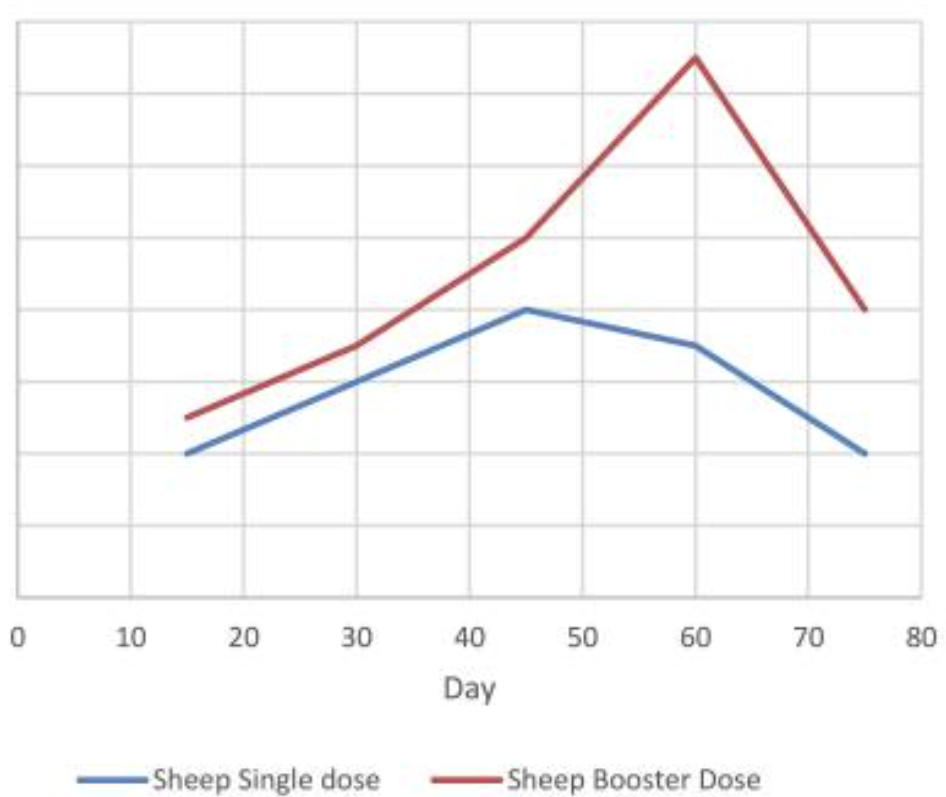
Timing of when vaccines are given is important. As you can see in the graph above, it takes a few weeks after vaccination for antibody levels to peak. You need to time your vaccine so that enough antibodies are being produced before the lambs are likely to be exposed to the pathogen. It takes time and a healthy immune system for an animal to mount a response to being vaccinated. Sick or stressed animals are not able to mount a good immune response. Vaccines are drugs and have drug withdrawal times, keep your sale plans in mind when planning your vaccine schedule.
Unless an animal is continuously being exposed to the pathogen, the antibody levels will decline over time. This is why most vaccines recommend an annual booster.
Buying and Storing Vaccines
Most sheep vaccines are available over the counter, and you can administer them yourself. You can get your veterinarian out to vaccinate your sheep, but that adds a lot of cost to the price of raising sheep. If you are new to sheep, you can ask your veterinarian or a shepherd mentor to show you how to do it the first time.
Although they are available over the counter in most of the country, some states may require a prescription or a “Certificate of Need” to purchase needles and syringes.
Syringes: Be sure to check the label information for the vaccine you are purchasing (most can easily be found online) to see what the dosage is. Vaccines have the same dose for lambs as adults and are not dosed by weight like other medications. Most vaccines are 1 or 2ml per dose, so a 3cc syringe works well, but some are 5ml per dose and require a 6cc syringe.
Disposable syringes for injection have two options for the tip of the syringe, luer slip or luer lock. Luer slip tips are smooth and the needle just slips over, while luer lock tips are threaded and you screw the needle on. Luer lock syringes secure the needle to the syringe better, so it is unlikely that your needle will pop off the syringe if you inject quickly.
Bottle mount vaccinator syringes are convenient if you are vaccinating large numbers of sheep, as you do not have to draw up each dose. They also come in different sizes, so make sure the one you get accommodates the dosage of the vaccine you are giving.
Needles: Needles come in different lengths and sizes; the length is listed in inches and the thickness in ga (gauge). The higher the ga, the thinner the needle, so a 24 ga needle is thin and a 12 ga needle is very beefy. A thinner needle causes less reaction from the sheep, but they are more likely to bend or break and it takes longer to inject because the vaccine is being passed through a very thin tube. You can inject quicker through a thicker needle, and they are less likely to break or bend, but the sheep will react more to being poked as it is a bigger needle. Vaccines are typically given under the skin (subcutaneously), (read the vaccine label to see what they recommend) so you do not need a very long needle. Personally, I like 1”x 20ga for subcutaneous injections.
Ideally you are using a new needle for each sheep you are vaccinating. You risk spreading disease through your flock in the same way that biting insects can spread disease from one animal to the next. Needles get blunt with increased use, so if you re-use needles for multiple animals, you will notice that it takes more effort to get the needle through the skin as you go on. This increased pressure makes it more likely that needles will bend, and that the sheep will jump. Do not keep injecting with a bent needle, they are likely to break. It is better to use thicker, shorter needles if you are going to use them for multiple animals, as they are less likely to break. There are higher quality (more expensive) stainless steel needles available for autoinjector syringes that stay sharp longer and are less likely to break, compared to single use (plastic hub) needles. It is still recommended to change out needles frequently.
Vaccines: Vaccines are different from other medications, which mostly are inorganic chemical compounds. Vaccines contain proteins that can denature if they are not stored correctly. Just like an unopened jug of pasteurized milk will grow bad things and degrade if you leave it on the counter, or even in the refrigerator if you keep it long after the expiration date, vaccines degrade and can become dangerous if not properly stored.
Vaccines can be purchased locally at your livestock supply store or your veterinarian. They should be stored in a refrigerator and feel cold when you get them. Be sure to check the expiration date before buying. Bring along a cooler to keep them at the right temperature for the ride home.
Most online pet/livestock supply stores sell vaccines too. They have to be shipped in a cooler with fast shipping, so there is added expense. Make sure that vaccines are still cold when they arrive, check the expiration date and promptly store them in the refrigerator. Keep the little cooler, and re-freeze the ice packs to keep your vaccines cold when you are taking them out to the barn to administer later.
Vaccines should be protected from freezing, so do not put your vaccine container right up against the surface of a frozen ice pack in a cooler. Put the ice pack in a paper bag or wrap the ice pack in newspaper or packing paper. This insulating layer protects the vaccine from freezing. It also helps to catch the condensation from the surface of ice packs as they start to melt so you do not end up with puddles in your cooler.
Vaccines should be kept refrigerated and protected from freezing. If you are storing vaccines for an extended time, keep them in the back and bottom of the refrigerator as temperatures should be colder and more stable there.
Check expiration dates, and do not use expired vaccines. Best case they are ineffective, and worst case, it can make your sheep sick. The same applies to vaccines that have not been kept at the right temperature.
Vaccines come in different size bottles, typically 10, 50 and 125 doses. They all have a statement to use the entire contents once it is opened. It is best to buy your vaccines in the smallest bottle that you will use up in one vaccination session. Be sure to buy a few extra doses; mishaps happen and you do not want to be a dose short.
Unfortunately, like a lot of medications these days, vaccines go on backorder from time to time so it is good to have your vaccines in hand a few weeks before you need them.
Administering Vaccines
Ideally the animals that you are vaccinating are clean and dry. As you push the needle into the sheep, you are pulling bacteria and dirt from the skin and hair into the injection tract. When animals are wet the dirt dissolves into the moisture and is more likely to be pulled in. There is a much larger risk of developing abscesses at the injection site if you are vaccinating wet or muddy animals. If the animal has a streak of mud or manure in its hair in the spot where you want to vaccinate, move over a few inches rather than going through the contaminated area.
Traditionally it is recommended to give vaccines in the armpit area. This recommendation is aimed at wool sheep where that is often the only easily accessible spot that is not covered in inches of wool, so it is easy to see where the vaccine goes. With hair sheep we have lots of other options, like over the ribs, or on the side of the neck. Like with any other injection, you want to stay away from the high value meat cuts, so DO NOT vaccinate in the back leg, shoulder or over the loin area. It is common to get some swelling in the area where you gave the vaccine, and some animals will end up with a long-lasting knot in the area. With this in mind, steer clear of where lymph nodes are as these swellings can resemble lymph node abscesses due to CL and cause unnecessary stress for the shepherd. Also, if you show animals, you might want to opt for a less visible area to give your vaccine. Some vaccine products cause a lot more reactions than others. Try to always administer vaccines in the same location, or record where you administered vaccines if you switch sites, to reduce worry when lumps show up after vaccination.
Vaccinate your sheep in a chute or pen them up together tightly to minimize movement when giving the vaccine. Proper restraint goes a long way to prevent bent and broken needles as well as accidental injection of the shepherd.
Read the vaccine label and give the vaccine as recommended. Most vaccines instructions are to give it under the skin (subcutaneously or subQ). You can see how to give subcutaneous injections here.
Keep vaccines cool, even while you are out vaccinating in the barn. If you are using multiple bottles of vaccine, keep the ones that are not yet in use in a cooler. If you are giving multiple vaccines, or other treatments at the same time, remember you should not mix them together in one syringe.
Be mindful of introducing dirt and bacteria into your vaccine bottle. Keep the bottle upright and ideally covered with something that is not touching the rubber stopper. This will help to keep dirt and dust out of the bottle. Do not put a used needle back into your vaccine bottle to draw up more vaccine – this can lead to a nasty bacterial soup by the end of your vaccination session, especially if it is hot; it also will blunt your needles twice as fast.
Most vaccines are given annually to ewes in the last 3-4 weeks before the start of lambing. The lambs are usually vaccinated at 8 weeks old, with a booster at 12 weeks old. It is best to have at least the first vaccine in the lambs about two weeks before weaning. It is convenient to do vaccines at the time of weaning because you are already working with the sheep, but you will get a better immune response if you do not combine a vaccine with the stress of weaning.
Adverse Effects: It is common for sheep to get a small lump in the area where a vaccine was given and most will resolve quickly. Some are more long lasting and can form scar tissue; some vaccines are more likely to do this than others. Any injection can lead to an abscess forming. If you are seeing more than an occasional abscess, you should look at your technique. You are introducing bacteria along with the vaccine.
Although it rarely happens, individual animals can have adverse reactions to vaccines. All vaccine labels carry a statement that the vaccine might cause anaphylaxis along with a recommendation to have epinephrine on hand. Talk to your veterinarian about getting epinephrine and how to administer it. If you have multiple animals that were vaccinated with the same vaccine that had issues, please contact the company and let them know (their phone number is on the vaccine label; be sure to have the lot number handy). If you have animals that are acting sick after vaccines, don’t just assume that they will be better tomorrow. Examine them the same as you would an animal that acts sick on another day. Most will probably still be eating and drinking, just a little off, like you feel after a vaccine. Be on the lookout for high fevers, trouble breathing, very pale or bright red eyelid color, very fast heart rates, altered mental states and contact your veterinarian if you are concerned.
Make a note of the lot number before disposing of your vaccine bottle, that way you have the information if a problem should arise after a day or two.
Available Vaccines
Clostridial Vaccines
Clostridia are bacteria that grow well in low oxygen environments. Some produce deadly toxins and most produce spores that can live in the environment (typically in soil) for a long time. Some clostridium species can be normal flora in the intestinal tract and only cause disease in specific circumstances. The majority of available sheep vaccines are against various combinations of clostridium species.
Clostridium Tetani (Tetanus, lock jaw)
Sheep and horses are more susceptible to developing tetanus than other animals. Spores of this bacterium can remain viable in the soil for years and require a wound to enter the sheep. Wounds that are deep, contain dying tissue (banded tails or testicles), and wounds associated with bruising are low oxygen environments and allow this bacterium to rapidly multiply and produce a potent neurotoxin. Tetanus starts with a stiff gait that progresses to muscle spasms that progressively get worse, especially if the animal is stimulated by noise, light or touch. Unless treated very early and aggressively most animals that get tetanus die.
Clostridium Perfringens (Enterotoxemia, overeating disease, pulpy kidney, red gut)
There are four subtypes to this organism (Type A – D), classified according to the toxin that they produce.
- Type A can be a problem on specific farms, but is not a big concern in general
- Type B is typically not a problem in the USA
- Type C&D cause enterotoxemia
There is not a specific vaccine for types A and B, but there are various levels of cross protection to these types provided by Type C & D vaccines.
Clostridium perfringens is part of the normal intestinal flora. Sudden changes in nutrition, especially a sudden increase in carbohydrates, can cause it to massively proliferate. A deadly enterotoxin is produced and often the only sign farmers see is that their biggest, fattest lambs are just found dead. Lambs that are sick from enterotoxemia will often be hunched up, grind their teeth and feel really miserable; occasionally they can also have diarrhea.
Enterotoxemia is more common in sheep on high concentrate rations but lush, spring grass that is high in sugars can also lead to enterotoxemia. In general type C affects lambs under a month old and older lambs typically are affected by type D.
Bottle fed lambs are very susceptible. They often did not get enough colostrum and their eating habits are a lot different from dam raised lambs that get small meals often vs fewer, larger meals for bottle raised lambs.
The most common sheep vaccine is CDT, which is a combination of Clostridium perfringens Types C&D and Clostridium tetani. There are different brand names of this vaccine available. You can also find just tetanus and just C&D vaccines on their own.
Vaccines for enterotoxemia (CD) and tetanus (T) are available as two distinct products, make sure that you get the right one for your situation.
- Toxoid – This is the vaccine and is given preventatively. You need two doses 3-4 weeks apart to develop full immunity. Repeat the vaccination annually and booster when an animal is injured. Lambs that are castrated or have their tails docked using elastrator bands are at high risk of developing tetanus. From an animal welfare standpoint, it is recommended to band tails and testicles within the first week of life. Vaccinating the ewes about 4 weeks before lambing will boost their immunity to tetanus and enterotoxemia and they should confer immunity to tetanus and enterotoxemia to their lambs through colostrum. Look closely, there are CDT toxoids, CD only toxoids and tetanus only toxoids.
- Antitoxin – This product is a treatment for animals that are affected by tetanus/enterotoxemia. It can also be given to animals that are not up to date on their tetanus vaccinations when they have an injury to prevent tetanus. Giving the antitoxin at time of banding is also an option for imparting immunity to lambs if their dams have not been vaccinated, or to bottle lambs that did not get enough colostrum. This product has been on backorder multiple times over the past few years, so it is not always available. There is not a combined CDT antitoxin, but CD antitoxin and Tetanus antitoxin are available.
On a lot of farms, the only vaccine that is given to ewes, rams and lambs is CDT. The vaccine is effective, with an annual booster. Incidentally, if you have goats too, they do not respond as well to CDT vaccinations and it is recommended to vaccinate them twice a year, or even more frequently if they are maintained on a high energy ration.
Timing of CDT Vaccines: The sheep will have higher CDT antibodies for a few months after their annual boosters. Boostering ewes about 4 weeks before the start of lambing will ensure higher CDT antibodies in their colostrum to protect their lambs for the first weeks of life. This timing also gives the ewe extra protection when you are feeding higher energy feeds in late gestation and during lactation.
We will discuss findings from a study about optimal vaccine scheduling. Previous studies have found that antibody levels of 0.15-0.2 IU/ml are necessary for protection against enterotoxemia.
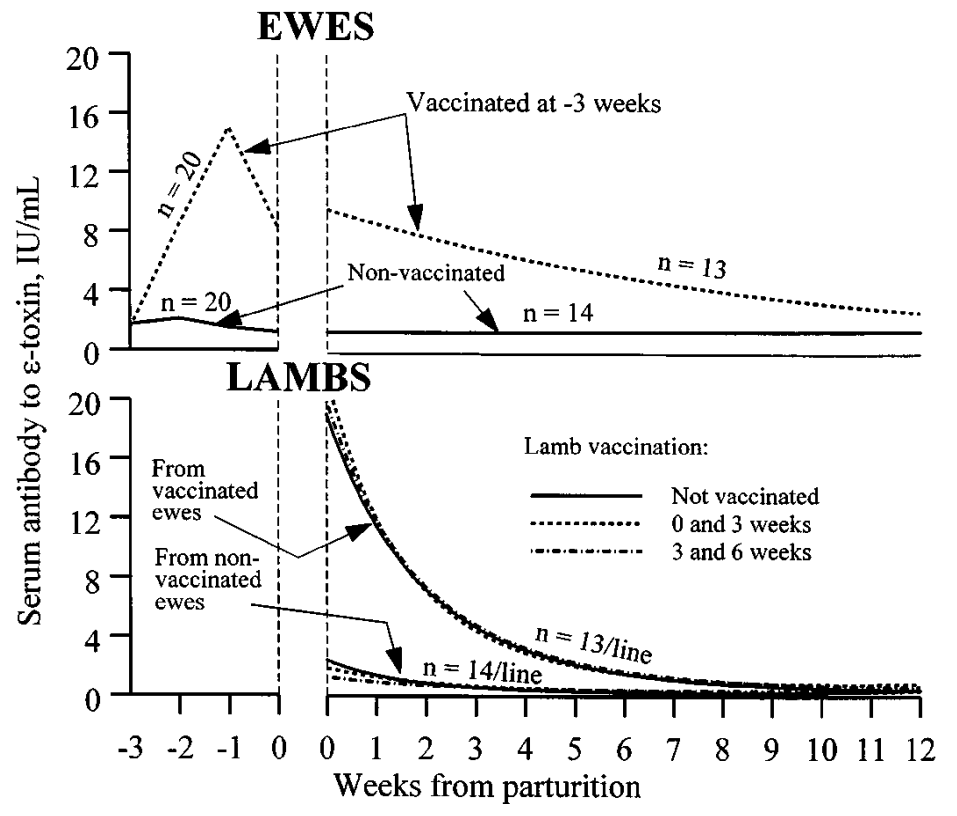
The ewes in the graph below were used in an accelerated lambing system and continuously on a high level of nutrition. They were at least three years old and had been vaccinated as ewe lambs and had received boosters annually. When they were due for their annual booster vaccines, half the ewes were given a booster vaccine 3 weeks before lambing and the others were not. On average the ewes still had protective antibody levels throughout the experiment, whether they were vaccinated or not.
You can see that the vaccinated ewes rapidly increase their antibody titers after receiving a booster. You get a quicker antibody response in an animal that has been vaccinated before (they already know how to make this antibody), compared to the lambs in the graph at the beginning of the article. In both the vaccinated and unvaccinated ewes their antibody levels dip just before lambing. The antibodies in colostrum come from the ewe, so antibodies are removed from her bloodstream in order to make colostrum.
You can see that vaccinated ewes maintain elevated antibody levels for many weeks, so do not worry if you bred your ewes for three or four cycles. The ewes that lamb at the end of the lambing window should still have high enough antibody levels to protect their lambs. The lambs out of vaccinated ewes had much higher antibody levels at lambing when compared to lambs out of unvaccinated ewes.
In the same study, 33% of the lambs were not vaccinated at all, 33% were vaccinated at lambing and boosted at three weeks old and the rest were vaccinated at three weeks and got a booster vaccine at six weeks old. There were no changes in antibody levels in the lambs between the three groups of lambs, when they were followed for twelve weeks. Really young lambs simply do not respond well to vaccination.
Other Clostridial Diseases
There are additional Clostridial diseases that can cause disease in sheep in certain circumstances.
- Clostridium chauvoei causes black leg, an often fatal gangrene of large muscles.
- Clostridium novyi causes black disease, an often fatal liver necrosis in sheep with liver damage due to live flukes. It can also cause big head
- Clostridium septicum causes malignant edema, an often fatal gas gangrene.
- Clostridium sordelli is also a cause of malignant edema and big head but can also cause sudden death due to a lethal toxin.
- Clostridium haemolyticum causes red water disease, mainly in cattle, but sheep can also be affected.
The above Clostridial diseases can cause severe disease on some farms and are never seen on others. If you have liver flukes, or valuable rams that live together it is good insurance to use a Clostridial vaccine that includes Clostridium novyi and sordelli. Talk to your veterinarian and other producers (cattle and sheep) about the prevalence of these other Clostridial diseases in your area. They should be able to guide you in whether you need more than just a core CDT for prevention of Clostridial disease. In general, these diseases are deadly and not very treatable, so vaccination is very important to prevent losses. If you are risk averse you can always opt to include these other organisms in your clostridial vaccine even if they do not occur on your farm
If you are using one of the 7- or 8-way clostridial vaccines, be sure to check the label; many of them DO NOT contain tetanus, so you might have to give a separate tetanus vaccine or look for a different product.
Anytime you switch from CDT vaccination to one of the vaccines with protection against other clostridials, you should give a booster vaccine 3-4 weeks later, as this is the first time that your sheep are getting vaccinated against these organisms. If you just switch from one brand of CDT vaccine to another that is just CDT, you can just continue with your regular vaccine schedule..
Mannheimia haemolytica & Pasteurella multocida
This is a pneumonia vaccine, but it only offers protection to these two organisms. If you have ongoing problems with pneumonia, it is prudent to have cultures done to isolate the organisms that are causing problems.
This product is indicated for farms that have issues with pneumonia due to these organisms. It is also good to use it prophylactically if you have a lot of sheep coming and going off your farm. If you show animals, they are likely to pick up some kind of respiratory bug. Remember to isolate them when they come back home.
If you have pneumonia issues in really young lambs, then focus on vaccinating your ewes well (two doses 3-4 weeks apart initially) and booster them in late pregnancy to give maximal protection to your lambs through colostrum antibodies. If your pneumonia issues are typically in older lambs around weaning, vaccinating the ewes is still a good idea, but make sure that you give at least the first vaccine to lambs 2-3 weeks before weaning so they have time to develop immunity before the stress of weaning.
Anecdotally, producers that have mastitis due to these organisms have noticed improvements (less mastitis) when ewes are vaccinated.
This is the only pneumonia vaccine that is licensed for sheep. There are cattle vaccines available that cover a wider range of pneumonia-causing organisms. A lot of the cattle vaccines are available as an intranasal vaccine. In the face of a pneumonia outbreak, intranasal vaccines can be helpful to supply faster local immunity. Some producers that show animals also use the intranasal vaccines to protect against organisms not covered in the injectable sheep vaccine. This is off-label use, so talk to your veterinarian if it is appropriate for your farm, and also to get a proper drug withdrawal time (it will likely be longer than the time listed on the label for cattle).
The Mannheimia haemolytica & Pasteurella multocida sheep vaccine can be very beneficial on farms that have problems with pneumonia due to these two organisms and works best if given before pneumonia outbreaks. Initially vaccinate all animals on the farm, with booster vaccines 2-4 weeks later. Annually vaccinate adults 3-4 weeks before lambing. Lambs can be vaccinated at 8-12 weeks old, with a booster 2-4 weeks later. It can be tricky if you usually have pneumonia outbreaks right at weaning, if you wean at 8 weeks old. You can give the first vaccine at 6 weeks old, but lambs are not likely to respond well, so you might have to give two boosters.
Remember to keep drug withdrawal time in mind when vaccinating all sheep.
Caseous Lymphadenitis (CL)
This vaccine is indicated for the prevention of Caseous Lymphadenitis (CL) caused by Corynebacterium pseudotuberculosis. Although we all want to keep our sheep from getting CL, there are some considerations that limit the usefulness of this vaccine and most flocks DO NOT routinely use this vaccine. It is very useful though in flocks that already have CL.
CL is one of the three diseases that is routinely screened for in a biosecurity panel. Biosecurity screening, among other things, looks for antibodies to Corynebacterium pseudotuberculosis. Using this vaccine will give your sheep antibodies to Corynebacterium pseudotuberculosis and therefore complicate screening, as there is no way to differentiate between antibodies from the vaccine vs infection. A lot of producers will not buy CL vaccinated sheep due to this confounder.
There are other ways to keep CL out of your flock. Test incoming sheep, isolate any animals that show up with abscesses and culture the abscess contents to see if it is CL. Keep the animal isolated until you get the culture results back. Isolate the affected sheep in an area that is easy to clean and disinfect. All abscesses can possibly be CL, so treat all animals with abscesses as if they have CL until culture tells you otherwise.
If you have multiple animals that show up with abscesses that culture positive for CL, then vaccination is a good tool to manage the infection in your flock. The label for this vaccine recommends vaccinating in the armpit and giving a booster vaccine 4 weeks later in the opposite armpit. An annual booster is recommended.
Ovine Ecthyma (Sore mouth)
This is a live vaccine, so you are introducing sore mouth to your farm when using it. Generally, this vaccine is not recommended as a preventative but can be very useful if you already have this virus on your farm.
In a natural sore mouth infection lambs will get sores on their lips; they can pass it on to their dams when they suckle, and cause sores on their teats. The sores are very painful and lambs might not eat well and ewes can refuse to let their lambs nurse. This can predispose the ewes to bacterial mastitis.
This vaccine gives your lambs sore mouth, but you control when they get it, as well as where on their bodies the sore is. The vaccine comes with an applicator. One side is used to rub against the skin to roughen the skin surface in a bare spot on the inside of the thigh. The brush end is then dipped in the vaccine and vigorously rubbed into the roughened skin. After a few days you should notice that the area gets a sore indicating that the vaccine took. This sore will progress into a scab that will fall off after 2-4 weeks. People can get this disease, so be sure to wear gloves and cover any small cuts on unprotected skin when working with the vaccine. Also be sure to not touch your face and eyes while working with this vaccine.
Typically, all the lambs on the farm are vaccinated each year. With the vaccine, the sore mouth lesions are not on the mouth, so it does not interfere with the lamb nursing and it also makes it much less likely that the infection is transferred to the ewe. You can also make sure that all the lambs get sore mouth at a young age and at the same time and get over it. Lambs with active sore mouth lesions cannot go to shows or get a Certificate of Veterinary Inspection (CVI) to travel, so the vaccine makes sure that all the animals are over their sore mouth before show and sales season starts.
There are different strains of sore mouth virus, with some farms experiencing severe illness and others just noticing a scab here and there without the lambs showing any signs of discomfort. If you have a very mild strain on your farm, you might introduce more severe disease with the commercial vaccine. Consider asking your veterinarian to help you make an on-farm vaccine from scabs collected from your sheep.
Abortion Vaccines
Two vaccines are available against organisms that cause abortions in late pregnancy. Both these diseases are transmitted mainly through the fetus, fluids and membranes produced when a ewe aborts. Separating pregnant ewes as soon as they start to have vaginal discharge and penning them up in an easy-to-clean and disinfect area away from the other pregnant sheep go a long way to preventing disease spread. Sending in aborted fetuses and membranes for testing to see if any of these organisms are the cause of the abortion will help you decide on using these vaccines or not. Bringing in new ewes increases the risk of introducing these organisms. Rams can also spread Chlamydia.
Whether or not to use these vaccines depends on how risk averse you are. It can be devastating to have an abortion storm and these vaccines are effective. It takes some planning ahead as these vaccines need to be given before breeding and during pregnancy. Definitely use these vaccines if you have had abortion due to either of these organisms before, as you are likely to have more in the future.
- Chlamydia abortus This vaccine prevents Ovine Enzootic Abortion. It needs to be given 60 days before breeding with a booster 30 days later. The label says to give it in the upper neck area as it is likely to form lumps at the vaccination site that might be long lasting. It has a 60-day drug withdrawal.
- Campylobacter jejeni-fetus This vaccine prevents Ovine Genital Campylobacteriosis (Vibrio). It needs to be given shortly before breeding with a booster 60-90 days later. The label says to give it in the armpit area. It has a 21-day drug withdrawal.
Bovi-sera and Ovishield
Both these products are not vaccines but antibody products that can be used to provide immediate disease protection in unvaccinated animals. They are very similar to the Clostridial antitoxin products. They are useful for animals that did not get colostrum in a timely manner. Ovishield is derived from sheep serum, but they do not make a claim to have antibodies to specific pathogens. Bovi-sera is made from cattle serum and lists the pathogens that they have antibodies against. The protection does not last long and you might have to repeat doses. These products can also be used as treatments for animals affected by diseases that they have antibodies to.
Summary
A few questions to consider when deciding if a particular vaccine is indicated for your sheep:
- How bad is this disease? Are my sheep likely to die or have severe disease if they contract this disease naturally?
- Is this disease treatable? Is my management system conducive to catching the disease early to be able to treat before the animal is too compromised?
- How likely are my sheep to get this disease? Do I have other options for keeping my sheep from getting infected?
- Does this disease occur where I live? Am I likely to import it in animals that I buy in?
- Is this disease already on my farm and causing economic losses?
- Will controlling when my animals contract this disease have a benefit?
Hopefully the above information helps you to use vaccines more effectively. Every farm and every shepherd is different, and you need to decide which vaccines are appropriate for you. In general, diseases that are deadly, hard to treat, and/or difficult to exclude from your farm will give you the best return on your vaccination efforts and dollars. Discuss vaccinations with your veterinarian; they should have a good idea about which diseases are prevalent in your area.
Comments and questions can be sent to blogs@easternalliancekatahdins.com or join the conversation at https://www.facebook.com/easternalliancekatahdins
By: Isabel Richards, Gibraltar Farm

