
Lambing is an exciting time of year, especially when everything goes well. It’s also an economically important time; after all, you can’t sell lambs that don’t make it to weaning. Getting your lambs off to a good start goes a long way to ensuring an enjoyable and profitable lamb crop. The old adage “an ounce of prevention is worth a pound of cure” is good advice for shepherds since it’s easier and more effective to prevent illnesses than it is to treat sick lambs. Part I of this two-part series will discuss management tasks to prevent illness, critical times to identify problems and how to resolve them, as well as issues to watch out for in the first 30 days. Part II will cover health concerns of older lambs and weaning considerations.
Managing newborn lambs (First 24 hours)
Most lamb losses occur in the first few days after birth. There are some routine management tasks that will help reduce risk to newborns and help the shepherd identify individuals that might require additional intervention.
- Bedding
Keep the lambing area clean with dry bedding. Dirty bedding increases the risk of mastitis in the ewes, as well as diseases such as naval ill, joint ill, scours and watery mouth in the lambs. Clean, dry bedding helps to improve air quality and decreases the risk of pneumonia. If your bedding feels moist, and/or you can smell ammonia when kneeling at lamb level, you need more bedding. A deep bedded pack works well to keep lambs warm if you lamb in cold climates, just make sure you keep adding fresh bedding to keep the surface clean and dry.
In general, lambing on pasture provides a much cleaner environment. However, keeping sheep in one small pasture throughout the lambing season can lead to a pretty contaminated environment. Have a back-up plan for somewhere you can move your flock if it is a particularly wet or muddy lambing season, or consider rolling out straw or hay to provide cleaner bedding in the pasture.
- Keeping lambs warm
Lambs that are dry with a full belly and a wind break typically do well, even in very cold temperatures, and do not need additional heat. Fresh air is very important. Make sure that there are no cold drafts at lamb level. Even sheep with dry coats produce moisture and heat when they breathe. If you close up the barn too tightly, especially when it’s cold, the higher humidity will lead to poor air quality putting sheep at increased risk of disease. If your barn smells bad at human level when you walk in, it is much worse at the breathing level of ewes and lambs. High levels of ammonia in the air causes chemical damage to the protective mechanisms in airways and the lungs that prevent respiratory disease.
Have a plan for heating up chilled lambs. If you put your finger in a lamb’s mouth and it feels cold, you need to warm up the lamb promptly. This article has instructions on making a lamb warming box, as well as other very useful information for warming lambs. In cold weather, have a few lamb coats available for those that are ill or compromised to help them conserve their body reserves.

- Navel care
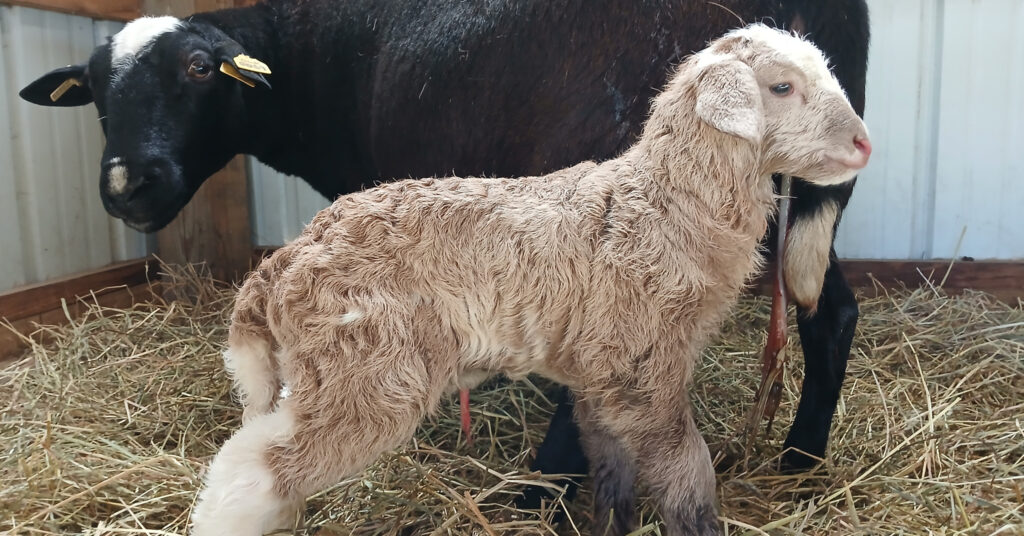
A wet navel/umbilical cord acts as a wick for bacteria. To prevent bacteria in the environment from entering the lamb’s bloodstream via the navel, it needs to dry up quickly to prevent diseases like joint ill, navel abscesses and sepsis. A long cord should be tied off (dental floss works well), then clipped to around 2” long, and then dipped (or sprayed) with a navel dip solution to kill bacteria and hasten drying. Most solutions contain iodine, alcohol, chlorhexidine or a combination and can be used as either a spray or a dip. Make sure you cover the entire cord as well as the skin where the cord enters the body.
- Tagging lambs
Tagging lambs before they leave the lambing jug ensures accurate identification of animals and reduces the risk of tag-related infection since this is the cleanest the lamb’s ears will ever be. Applying a small dab of antiseptic lubricant to the ear tag stem when inserting tags helps the tag go in smoother and also reduces the risk of infection. Strategic use of tag color or placement (right or left ear) can indicate sex, year of birth, sire, and birth type. With looped EID tags, leave at least ¼” space between the bend in the loop and the ear’s edge to allow room for the ear to grow without becoming pinched. For more ideas, see Ear Tags—An Essential Tool in Livestock Management
- Colostrum
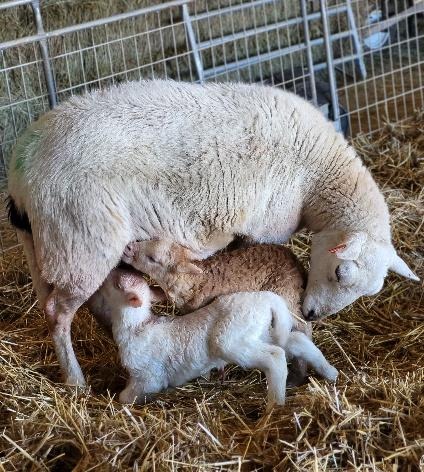
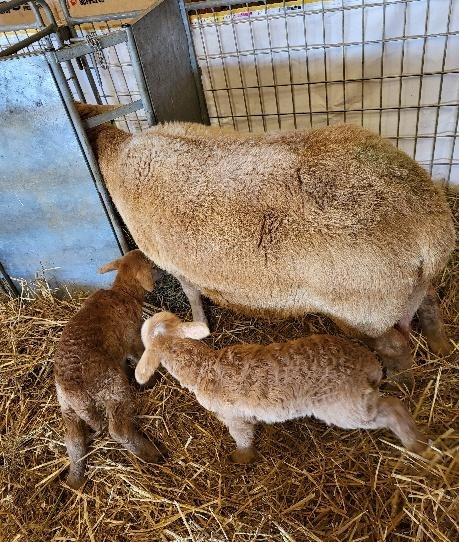
Colostrum provides the antibodies, nutrition, and energy necessary for lamb survival. It’s very important that lambs get adequate colostrum in the first 12-24 hours after birth. Identifying lambs that are struggling in this early timeframe, and providing adequate colostrum, can help prevent disease and lamb loss later on. Check that the ewe has a good milk stream in both teats and strip the wax plug if necessary. Newborns should nurse and then go to sleep. If you have a lamb that keeps crying, is hunched up or lethargic, check to see if it has a full belly, especially if its litter mate(s) are quiet and content. If the lamb’s mouth is warm but it has an empty belly, check the ewe’s udder. If it’s necessary to use artificial colostrum, be sure to use colostrum replacer (not supplement). Below, are different scenarios that result in hungry lambs and how to handle them.
- Does she have milk in both teats?
If the ewe only has one side of the udder producing milk, direct the lamb to the functioning side and help it latch on. If it drinks well and is content afterwards, keep watching and check on the lamb again in a few hours. Some ewes will keep directing the lamb to the non-functional side putting the lamb at great risk of dying or becoming a bottle lamb if it doesn’t figure out that it needs to drink from the working teat. MAKE A NOTE THAT THE EWE HAS A PROBLEM and cull her, otherwise you will be in the same boat next year.
- Does she have insufficient milk or no milk at all?
If the ewe has triplets or quads and some of the lambs have full bellies, but one is not doing well, she just might not have enough milk to go around. Tube feed the hungry lamb(s) with colostrum replacer and keep a close eye on them. She might be able to ramp up her milk production, or the lamb may get enough energy from the supplemental feeding to begin nursing, but most likely you’ll have a bottle lamb. If she’s a young ewe, she may not have this problem next year when she’s mature. MAKE A NOTE though, you might want to cull her.
If all the lambs have empty bellies, the ewe likely has no milk, even if the udder appears full. Feed all the lambs colostrum replacer and find them foster dams, or turn them into bottle lambs. Bottle lambs in this situation can be kept with their dam. It’s a bit more work, but the lambs will be healthier and the dam will teach them valuable lessons in being a sheep. Ovine progressive pneumonia (OPP) can cause hard bag. It’s prudent to test the ewe to see if you have this disease on your farm. MAKE A NOTE and cull the ewe.
- Does she have excessive swelling of the udder, teats and surrounding area?
Milk her out and tube feed the colostrum to her lambs. Often, milking the ewe once is enough to resolve the problem. If the edema is severe, it might require additional milkings, udder massage, anti-inflammatories and/or diuretics. Teats can become so enlarged (balloon teat) that the lamb can’t latch on. Milking the ewe and assisting the lamb to suckle large teats can help to resolve this issue. Some ewes will only have these problems once, while others are repeat offenders. MAKE A NOTE and consider culling the ewe, especially if the problem persists.
- Does she have a pendulous udder that makes it hard for a lamb to suckle?
Milk her out and tube feed her lambs with the colostrum. Sometimes lambs need a little assistance getting in the right position to nurse. Udder conformation is heritable and this type of udder makes it hard for lambs to nurse. MAKE A NOTE and cull the ewe unless you want to do this every year.
- Does her udder feel hard and warm?
If so, she probably has mastitis. Treat her promptly and feed her lambs colostrum replacer. She will not have good quality colostrum for her lambs in the timeframe that they need it. Training these lambs to take milk from a bottle is a good idea in case treatment of the ewe is not successful. Be cautious in grafting these lambs if they’ve suckled from their dam, the mastitis causing organisms are in their mouths and they can infect their foster dam. MAKE A NOTE and consider culling the ewe.
- Does she try to kick you when you touch her udder?
If the ewe is a first-time mother, she might not know what to do. Gently restrain her and assist the lambs to nurse. Usually, after a few minutes, enough oxytocin is released so that she will relax and her mothering instincts will kick in. Avoid stressing her out. If she is really wild, tube feed the lamb(s) colostrum replacer and place her in a headgate. Monitor the lambs, hopefully only a few hours in the headgate will sort her out.
OR
If the ewe has lambed before without previous problems, but now her udder seems sensitive to touch, the ewe is probably just starting with mastitis. Although not the best antibiotic stewardship, consider treating this ewe as if she has mastitis (antibiotics and anti-inflammatories) rather than waiting for it to get worse. You can try treating with just the anti-inflammatories in case her full udder is just tender, but keep a close eye, the earlier you can start treating mastitis, the better your chances are of having a good outcome.
OR
If the ewe is nursing her other lamb(s), but blocks/kicks one particular lamb, she is likely rejecting this one. Put her in a headgate and make sure the lamb gets colostrum. Milk out some colostrum and tube feed the lamb if she continues to be difficult, lies down or kicks. Keep monitoring the lamb until you are sure it is getting enough. Don’t release the family from the jug until you are sure the ewe has accepted the lamb and is no longer pushing it away. If the lamb is a triplet, and much smaller than its siblings, it might be best pulling it off as a bottle lamb, especially if the dam is being aggressive towards it. MAKE A NOTE and consider culling the ewe, even if a headgate solves the problem.
OR
If the ewe is sick, tube feed all the lambs with colostrum replacer, and treat the ewe. When the ewe recovers, she can probably raise her lambs, but in the meantime, you need to make sure they get enough colostrum in the first 24 hours and provide milk replacer until the ewe recovers enough to produce adequate milk for her lambs. Keeping the lambs with the ewe, or in an adjacent pen, will help maintain the maternal bond.
If all looks normal with the ewe, check the lamb:
- Will the lamb suckle on your finger?
Normal, healthy lambs will suckle on your finger if you put it in their mouths. Healthy lambs should be able to stand shortly after birth, and should appear bright and alert. If the lamb’s mouth feels warm and it is alert, tube feed it colostrum and check back in a few hours, hopefully the lamb will be suckling by then. If the lamb continues not being able to stand and/or suckle, keep tube feeding it and consult your veterinarian or a sheep mentor.
- Does the lamb’s mouth feel cold?
DO NOT FEED THIS LAMB. It needs to be warmed up first before feeding. If very depressed, the lamb might also need IP dextrose. Once the lamb is warm and alert, tube feed colostrum, put a lamb coat on and put the lamb back with its dam. Recheck often to make sure it’s warm and nursing. If the lamb is still depressed and unable to get up after IP glucose and being warmed up, consult your veterinarian on lamb mentor, do not just put it back with the dam, additional treatment is needed.
A lamb can only absorb colostrum for the first 12-24 hours. It is critical that the lambs get enough colostrum within this time frame. Do not wait to check on lambs that seem a little off.
- Tube feeding lambs
One of the most useful skills you can learn as a shepherd is how to tube feed a lamb. It can seem scary (and there is risk if you do it wrong) but it saves a lot of time and is a sure-fire way to ensure that lambs get enough colostrum, especially if the lambs are difficult getting started on a bottle and you are tired in the middle of lambing.
- Starting bottle lambs
To introduce lambs to a bottle, hold them close against your body in an upright position with your arm and use your same hand to position their head, while the other hand holds the bottle. Once they get the idea, lambs will take a bottle standing on their own. If a lamb has not been introduced to a bottle, it may not approach and nurse, even if it’s starving. Lambs less than 24 hours old are much easier to start than older lambs. If there’s any question a lamb may require supplementing later, it’s good to introduce the lamb to a bottle on day one. Once lambs are started, consider bucket feeding to reduce labor, especially for multiple bottle lambs. The Orphan Lamb Considerations blog has some more detailed information about feeding and caring for bottle lambs.
- Orphan lamb grafting
There are several reasons to graft lambs to a foster mother, or in case of rejection, even to their own mother. Ewes may have too many lambs, or there may be one lamb who is much smaller than its siblings and not able to compete well. Mismothering events may create situations where lambs need to be grafted to their natural mother or to a foster ewe. Grafting works best with newborns who are less than 24 hours old but can be successful at 2-3 days of age with a little patience. Active, vigorous lambs seem to catch on the quickest. You can find more detailed information in the Lamb Grafting Tips blog
Health concerns of young lambs (birth to 30 days old)
Most health concerns and diseases affecting baby lambs are caused by inadequate colostrum, starvation and/or bacteria in the environment. Keeping your ewes healthy and well fed, and providing a clean and dry lamb rearing area are some of the best ways to reduce the risk of infection and prevent problems.
- Starvation
It’s important to make sure lambs are getting milk. Starvation is a common cause of death in young lambs. At least once or twice a day, walk through all the ewes and lambs and get all the lambs up. Healthy lambs nurse frequently, have warm mouths, and stretch when they get up. Watch for lambs that are lethargic, hunched up, or stealing milk from other ewes. Pick up these lambs, check if their mouths are warm and if their bellies are full. Take a temperature to see if they are sick and check their dams for mastitis, or other illness. Mark the lamb and note its ID to make it easier to find its dam in case one or both needs treatment. Often lambs are in this situation because their dam does not have enough milk for all her lambs. Sometimes larger, more aggressive lambs will prevent smaller siblings from getting their fair share. A ewe with subacute mastitis from a previous lambing may have a full udder but little or no milk. Watch for lambs that fail to thrive or twins growing at much different rates, especially if they had similar birth weights. The ewe may have very little milk on only one side. The lamb on that side will typically not use the good side if they can get even a little milk and may need to be supplemented with a bottle. Make sure ewes are not rejecting a lamb. In case of rejection, putting the ewe back in the jug or in a headgate could prevent having to bottle feed the lamb. In any case, MAKE A NOTE about the dam of these lambs, and consider culling her, especially if it happens again.
- Constipation
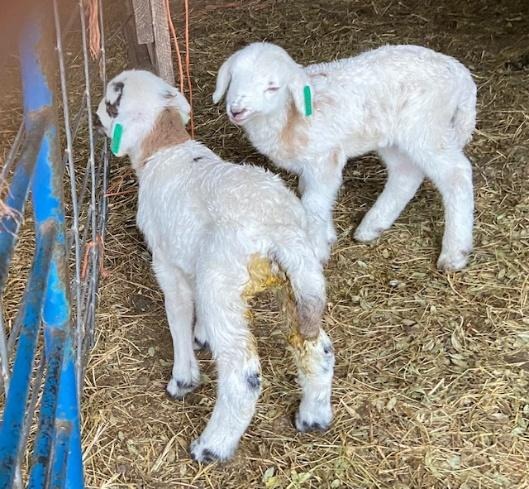
Whenever you have lambs that are depressed or not feeling well, it is good to take a look under their tails. Young lambs, especially singles whose dams have lots of milk, can often get pasty yellow stool that gets stuck in the hair under their tails and prevents them from passing stool. When you gently remove this obstruction, you will often see lots of new stool coming out and the lamb will feel instantly better.
- Castration and tail docking
Katahdins do not require tail docking, but some producers do castrate male animals to make management easier. Make sure that your ewes get booster CDT vaccines in late pregnancy to ensure that her lambs have protection against tetanus. If ewes are not vaccinated, give your lambs tetanus antitoxin at the time of banding.
Some neonatal diseases to watch for include:
- Watery Mouth
Watery mouth (also known as rattle belly or floppy lamb disease) is an often-fatal disease of newborn lambs caused by ingestion of E. coli bacteria usually from a dirty, muddy or wet environment. It affects lambs 12-72 hours old that have not ingested sufficient colostrum. Without the antibodies provided by colostrum, the bacteria rapidly multiply and trigger a chain reaction in the lamb’s gut. The gut motility stops and the stomach fills with gas resulting in a painful belly that causes the lamb to flop around in discomfort. The lamb may present with a wet muzzle caused by excessive salivation and a full belly appearance but will refuse to nurse and is lethargic and/or hypothermic. Lambs with watery mouth should not be fed milk replacer. Treatment usually requires antibiotics from your vet. Lambs most at risk are small lambs from a large litter born late (when the environment is more contaminated) who don’t receive adequate colostrum.
- Joint Ill (or Navel Ill)
This is a relatively common bacterial infection in lambs 1-4 weeks of age. Bacteria enter the bloodstream via the navel, after tagging, or castration. Early signs include a sudden onset of lameness in one or more legs, warm and swollen joints, fever, and anorexia. Antibiotics should be initiated early to prevent severe infection or death. Failure to complete the full course of antibiotics will often result in recurrence and permanent joint damage. To reduce risk, dip navels with iodine soon after birth, use an antiseptic during invasive procedures, and keep bedding clean and dry to reduce bacterial contamination. Lambs who have received adequate colostrum are less likely to become affected due to a stronger immune system. For more information see the Cornell University’s SOP on Joint Ill in lambs
- Scours
Scours occurring in dam-raised newborn lambs are usually caused by bacteria, viruses or protozoan infections and can be prevented by ensuring adequate colostrum and a clean environment. Scours in artificially-reared lambs can be caused by the same organisms but is usually due to improper mixing, feeding and storage of milk replacer. You can find more information in the Scours: Causes, Treatment and Prevention Blog
- Lamb Pneumonia
Lambs with pneumonia look depressed or lethargic and do not nurse well. They often have raspy breathing, nasal discharge, cough and/or fever. If newborn lambs with pneumonia are not treated promptly, they can rapidly develop sepsis and die. Neonatal pneumonia is more frequently seen in flocks that lamb in barns so ensuring clean, dry bedding and adequate ventilation without drafts will go a long way in preventing disease. The bacteria causing pneumonia in baby lambs can be spread to their dam’s udder when nursing, increasing the risk of mastitis in their dams. Lambs that do not receive an adequate amount of high-quality colostrum are more likely to succumb to pneumonia. Aspiration of birthing fluids is another cause of neonatal pneumonia especially in lambs born hind feet first. These lambs should have their airway cleared and breathing assessed immediately after birth. Incorrect placement of feeding tubes or improper bottle feeding can cause the lamb to aspirate milk leading to pneumonia.
- White Muscle disease
White Muscle disease is caused by a deficiency in selenium and/or vitamin E resulting in muscle degeneration in young lambs. Lambs with this disease appear stiff, hunched and are reluctant to move due to pain. If their heart muscles are affected, lambs can die. In areas with known selenium deficiency, producers should consult their veterinarian, nutritionist or grazing specialist on ways to provide supplemental/dietary selenium and vitamin E to ewes prior to breeding. An injectable form of selenium (BoSe) can be given to newborn lambs via veterinary prescription and requires careful dosing, since too much selenium can be toxic. If you have to treat lambs for white muscle disease, be sure to adjust your mineral program and add Vitamins ADE to the ewes’ diets (especially if they eat mainly hay during pregnancy). This disease is much better handled by prevention rather than treating lambs.
- Soremouth (Contagious Ecthyma, Orf)
Contagious ecthyma, orf or soremouth is a virus affecting sheep. Lambs are more often affected since many mature sheep already have immunity to it on farms where this disease is prevalent. Orf causes painful, scabby lesions of the lips, muzzle and mouth of sheep and usually runs its course in 10 days to 3-4 weeks. Since orf is caused by a virus, antibiotics are ineffective. Provide supportive care; be sure lambs continue to nurse, and do not scrub or pick off scabs. The virus can also spread to a ewe’s teats by infected lambs, predisposing the ewe to mastitis. Orf is one of the “pox” viruses and is transmissible to humans via contact with the sores of infected animals or from surfaces contaminated by the virus such as feeders, waterers, equipment, soil, or bedding. Isolating affected lambs and their dams may help prevent further spread. Animals are no longer contagious once scabs have fallen off and the underlying tissue is completely healed over. Vaccination for ovine ecthyma can be an effective management strategy for affected flocks.
Good management can go a long way to preventing problems at lambing. A clean lambing and lamb rearing area will prevent a lot of the above diseases. Making sure your ewes are vaccinated, healthy and in ideal body condition will help ensure ewes have enough good quality colostrum which should reduce the incidence of disease and help minimize the need for lambing assistance. Culling ewes with mastitis and those that reject or lose lambs to starvation will decrease the incidence over time.
Comments and questions can be sent to blogs@easternalliancekatahdins.com or join the conversation at https://www.facebook.com/easternalliancekatahdins
By: EAPK Communications Committee

