
There are a lot of preventable problems that can arise during lambing season, derailing the health and productivity of your ewes and lamb crop. Below is a compilation of management tips to help keep your pregnant ewes healthy, get your lambs off to a good start and decrease the stress and workload for tired shepherds. These tips are compiled from EAPK blogs and newsletters published during 2021-2025.
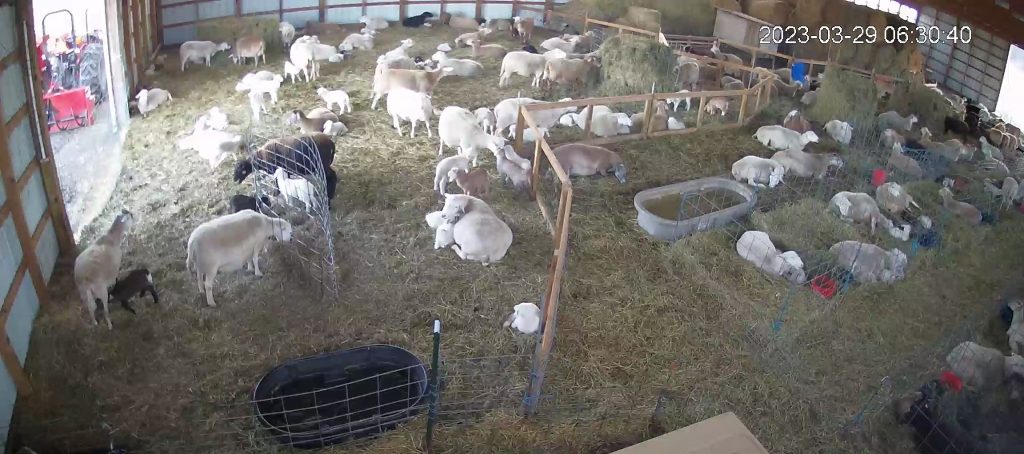
Preparation for lambing
Nutrition and exercise
Make sure that you are providing adequate nutrition and exercise for your ewe flock to ensure healthy ewes and lambs.
Nutritional requirements
Ewes have much higher nutritional requirements during the last few weeks of gestation as well as during lactation. Information about the nutritional needs of ewes at different production stages can be found in the Late Gestation Management Considerations Blog
Minerals
Make sure to keep up with your mineral supplementation. Adequate mineral nutrition is essential for good conception, lamb development during pregnancy, as well as the general health of your ewes and lambs. You can find more information about minerals in the Evaluating Your Mineral Program Blog
Pregnancy diagnosis
Knowing if your ewes are pregnant and how many lambs they are carrying can help you to allocate the feedstuffs that you have on hand to target the highest quality feed for the ewes that need it most. The different options for finding out if your ewes are pregnant and how many lambs they are carrying can be found in the Pregnancy Diagnosis Blog
Body condition scoring (BCS)
Making sure that your ewes are in suitable body condition during late pregnancy can help ensure healthy lambs and ewes. You can learn when, why and how to do BCS in the Body Condition Score – Why is it so Important Blog
Prenatal fitness
Exercise isn’t just good for the shepherd. In addition to a balanced diet, sheep benefit from regular exercise. Pregnant ewes who receive moderate exercise during gestation are less likely to have dystocia, have less gestational weight gain and may have enhanced colostrum quality. Spacing out hay feeders, waterers, minerals and shelter will encourage ewes to walk. Watch heavily pregnant ewes during bad weather though, as having easy access to feed, shelter and water may help to avoid pregnancy toxemia.
Items to have on hand
Supplies
Don’t forget to check and restock your lambing supplies. It’s especially important now that antibiotics must be obtained through your veterinarian and some supplies are on backorder. A full list of lambing supplies as well as suggestions for additional supplies to have on hand can be found in The Shepherd’s Toolbox Blog. A few lambing-specific supplies to have on hand:
- Propylene glycol, red wine, molasses or karo syrup: Quick treatment for pregnancy toxemia.
- Calcium gluconate 23%: Keep on hand for ewes with hypocalcemia; it can be given as an injection or by mouth.
- Prolapse harness or spoon: Most prolapses occur in the last 2 weeks of pregnancy.
- OB gloves and lube: For vaginal or uterine prolapse repair, as well as dystocia or assisted deliveries.
- Iodine Spray: Spray or dip newborn lambs’ navel and surrounding skin to prevent infection.
- Tube feeder: Provides quick delivery of nutrition for weak lambs.
- Bottles, nipples, colostrum and milk replacer: Used to feed and supplement lambs.
- Lamb sling: Can be used to move and/or weigh newborn lambs.
- Small, digital hanging scale (a fish scale works well): To get birth weights and track weight gain on lambs that are sick or struggling. A digital scale makes it easier to detect small weight changes as it provides weights in increments of pounds.
- Antibiotics: Have on hand for ewes after assisted deliveries and for treatment of disease that might crop up in ewes and lambs.
- Banamine or Meloxicam: You will need to get this from your veterinarian. Pain medications for ewes with pregnancy toxemia or ewes that are painful after difficult deliveries
- Veterinarian and/or sheep mentor contact information: While not a supply, be sure to have this information handy in case of an emergency.
Facilities and handling equipment
You need a way to catch and at least temporarily pen up ewes and lambs if you need to intervene during lambing. The size of your flock, your ewe’s temperament and whether you are lambing on pasture or in a barn will determine what you need. Many producers also place ewes and newborn lambs in individual pens or jugs for a short time after lambing to encourage bonding. You can see some suggestions in the Small Flock Lambing Facilities Blog
If you would like some ideas on how other shepherds manage their lambing flow, you can see the setup at three different farms in this producer profile Lambing Flow in Different Operations
Colostrum
Make sure you have colostrum or colostrum replacer on hand in case you have orphan lambs or if ewes do not produce enough colostrum for all their lambs. It’s good to have at least a small amount of milk replacer on hand too, for unexpected bottle lambs. You can learn more in the Colostrum Blog
Ear tags
Tags serve many purposes, but the primary one is animal identification. Tags can be ordered from several sheep and/or animal health supply companies. Blank tags are available and you can write on them with a special tag pen. Many companies will pre-print customized ear tags for you, just be sure to allow extra time for this.
Lambing records
Think through what information you want to collect about your ewes and their lambs around lambing. You might think that you’ll never forget, but will you really remember which ewes needed lambing assistance, or needed to be put in a head gate to accept her lamb when you have to make culling decisions two or three months later or next year when the behavior is repeated? Collecting date of birth, sire and dam, sex, birth type, birthweight, lamb ID, and any problems with the birth or with the lamb, should help with evaluating ewe and lamb performance. Birth weights are helpful to monitor growth of weak,sick or small lambs and if you plan on calculating the average daily gain (ADG) of your lambs.
You need to decide if you want to keep paper records, electronic records or both, and where to keep the information readily at hand so you don’t have to try and remember to record things when you get back home. Do you want to keep a clipboard on each jug, have a little notebook, have a central record somewhere in the barn? Do you want to make a lambing sheet to remind you to record all the information that you want for each ewe? If you are using electronic records in areas where it is really cold, remember that most personal electronic devices (cellphones, tablets) do not work well in very low temperatures, you might need to carry them on your person or have a heated cabinet to store them in. For suggestions on what information to record, even if you don’t submit data to NSIP, the Birth Records section in the Data Collection for NSIP Blog may be helpful.
Vaccinate pregnant ewes
As lambing nears, remember to give your ewes an annual CDT booster 4 weeks before lambing. This provides tetanus protection for ewes in case of any internal bruising or injury related to lambing, as well as ensuring high antibody levels in the colostrum to protect young lambs against both tetanus and clostridial disease.
Last week before lambing
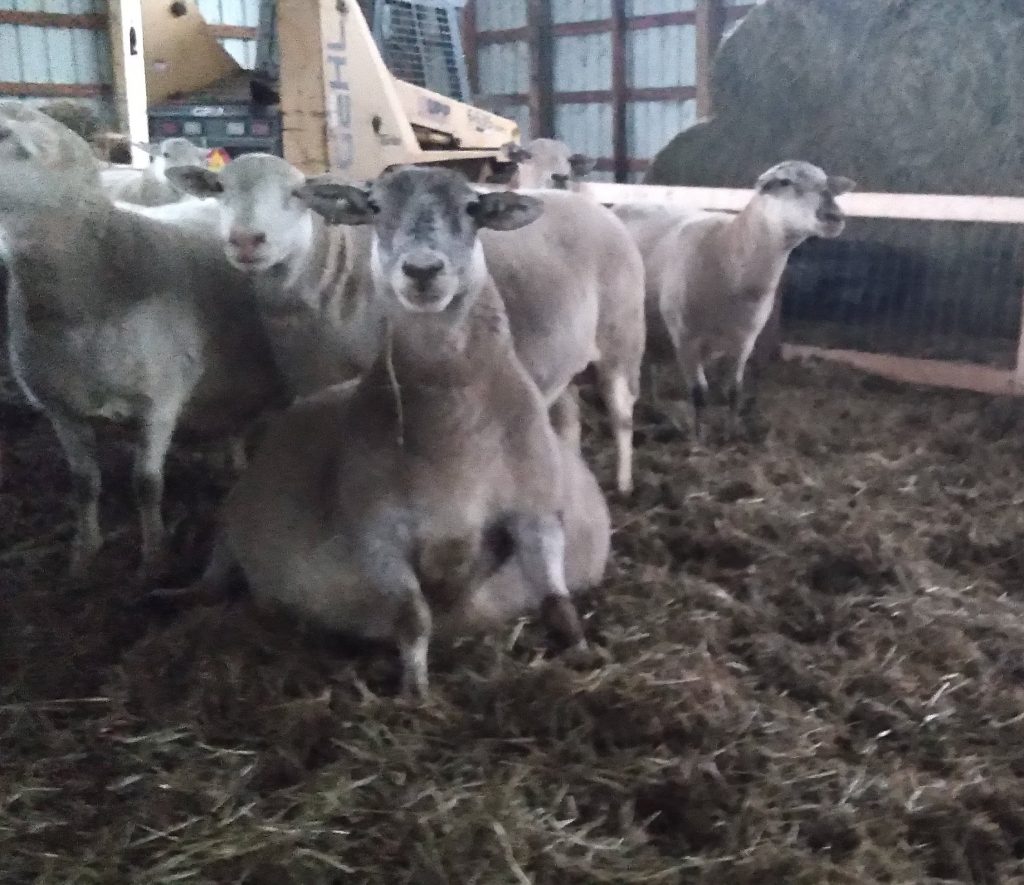
Lambing is just around the corner. Remember some ewes might not read the book and may lamb a little earlier than expected. Is the barn organized, at least a few jugs at the ready, did you check that your cameras and heat lamps are working, do you have fresh bedding spread out? Now is the time to bring your gloves and lubricant to the barn. Make sure you have tube feeding and bottle-feeding supplies clean and ready at hand. Are your barn records ready to go, do you have the veterinarian or a sheep mentor’s phone number handy in case of emergency? Consider a small refresher course on when and how to intervene if things go wrong with lambing in the Lambing Interventions Blog
Conditions to watch out for around lambing
Watch your heavy pregnant ewes closely and make sure they are eating. Treat any injury or disease promptly as anything that prevents a ewe from getting up and eating can lead to ketosis. You can find out what the signs of common diseases are in the Signs and symptoms: What are Your Sheep Trying to Tell You Blog
Pregnancy toxemia (Ketosis)
During the last 4 weeks of pregnancy the rapidly growing lambs vastly increases ewes’ requirements for energy, while the bulk of the growing lambs decreases her capacity to eat large amounts of food. Pregnancy toxemia/ketosis results when the feed is not energy dense enough to allow the ewe to maintain her blood glucose levels. Overly thin and fat ewes are at increased risk. Initially you will see a ewe that is depressed, often separate from the other ewes, not eating well and unsteady when walking. Unless treated promptly the ewe will progress to weakness, inability to get up, tremors, blindness, seizures and eventually death. A urine sample will test positive for ketones, although this isn’t necessary to initiate treatment. Treat with red wine, and/or propylene glycol drench and Banamine; also add electrolytes.
If you have recently noticed a box of red wine on your veterinarian’s truck, don’t worry, they are not drinking on the job. A study in dairy cows in 2022 compared different treatments for ketosis in cows. They found that the cows treated with red wine had the best outcomes. No studies have been done in sheep so far, but anecdotally veterinarians have had good results using red wine in combination, or instead of, propylene glycol. Typical dosage is 100 – 200ml twice a day for a 200 pound ewe. It does not have to be expensive wine, get the cheapest red wine you can find and save the nice stuff to celebrate a successful lambing season. Propylene glycol has a negative effect on rumen microbes and can cause poor appetite if given for multiple days in a row. Luckily red wine does not have this detrimental effect.
Alcoholic beverages of different kinds have been used to boost appetite and rumen health in sheep. A raw egg beaten into 8oz of beer, or stout (dark beer) are also anecdotal remedies for ketosis. Interestingly enough, in the red wine study, they used grain alcohol as one of their treatments and it worked, but something in addition to the alcohol in red wine made cows respond better.
Prevention is your best defense against pregnancy toxemia. Aggressive treatment, at the first sign of disease, leads to much better outcomes. Talk to your veterinarian, and have a treatment plan (and all the necessary supplies) on hand before you have a sick ewe. Hours matter and the sooner you can start treatment, the more likely you are to have a good outcome.
Milk fever (hypocalcemia) presents with similar signs and the two conditions often occur concurrently. The prognosis for a ewe that is already down is poor, especially if she is fat. Inducing labor or a c-section can be tried if not responding to treatment. It is best to prevent this condition by breeding ewes at an appropriate body condition and supplying an energy dense diet in the last weeks of pregnancy. https://www.sheepandgoat.com/pregtox
Milk fever (Hypocalcemia)
A ewe develops milk fever when she does not have enough calcium to support the normal functioning of her muscles. This usually happens in late pregnancy but can occasionally happen after lambing. You will find a ewe that has muscle weakness that progresses to going down and being unable to get up. https://www.sheepandgoat.com/milkfever.
Video: Identifying and Treating Milk Fever and Ketosis
Watch out for oral cow calcium products with calcium in the form of calcium chloride. It is a very acidic compound and can burn a ewes mouth and throat and cause her to go off feed. A better choice would be a product with other sources of calcium to give to your ewes.
Your veterinarian will probably treat your ewe with IV calcium. It is safer for farmers to give calcium under the skin or orally, unless instructed differently by your veterinarian. IV calcium given to a ewe that does not have hypocalcemia, or giving it too fast can be deadly.
- Calcium gluconate 23% is the go-to treatment for milk fever. It can be given orally or injected.
- Tums antacids can be used to supplement calcium. You might already have it in your medicine cabinet and some ewes might even eat it like a treat.
- “CMPK” products also supply magnesium, phosphorus and potassium and helps address deficiencies in these elements too.
Prolapse or Labor? What’s going on here?
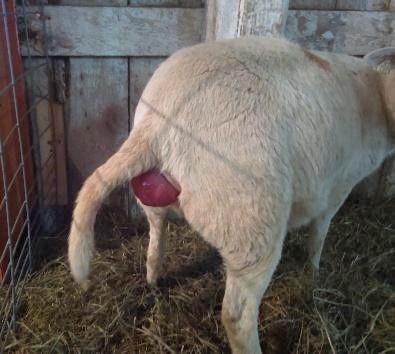
Prolapse: An early vaginal prolapse will appear as a small pinkish-red vaginal bulge, usually close to lambing. Often the ewe is seen straining while lying down. The bulge often retracts back into the vagina when standing. If left untreated, it becomes progressively more serious as more of the vagina is pushed out. Early intervention could save the life of the ewe and her unborn lambs. You can learn more about preventing and treating vaginal and uterine prolapses in the Prolapses in Sheep Blog
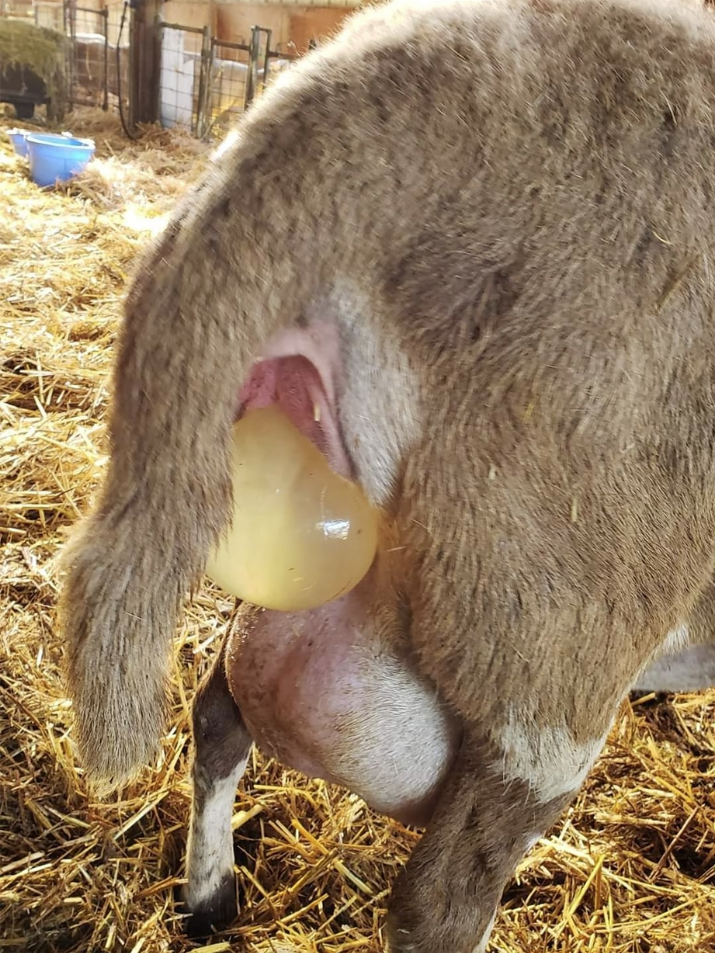
Labor: When lambing is imminent, a fluid filled sac appears from the vagina. The initial sac is usually filled with a pale yellow, sometimes tea colored fluid. Once this sac is visible, the ewe should be pushing and a lamb should appear shortly. After the first lamb is born more sacs will appear with very dark, bright red, yellow or tea colored fluid. Learn more about when assistance is necessary in the Lambing Interventions Blog
Prepubic tendon rupture: This condition occasionally affects ewes in late pregnancy. The muscles and tendons supporting the abdominal contents can sometimes just not take the strain of lots of lambs and food in a ewe’s abdomen at the end of pregnancy. You can learn more about this condition in the Prepubic Tendon Rupture Blog
Managing ewes and lambs after lambing
Hopefully, everything goes well and all the ewes are taking care of their healthy lambs and you just get to enjoy your new lamb crop. There are some routine management tasks to perform to evaluate the health of your ewes and lambs and identify individuals that might require additional intervention.
Lambing management
Have all your supplies ready before the first lambs are due. If lambing on pasture, be sure to have a bucket or a toolbox with your birthing supplies and lamb tags ready to go and a way to pen up a ewe if you need to intervene. Having lamb slings available to carry the lambs, with their dam following close behind, is an efficient way to get the whole family to a jug or to the barn if there is a problem. Slings also work if you’re just trying to separate the new family from ewes yet to lamb. Be sure not to disturb the new family until bonding is complete or you may have difficulty getting the ewe to leave her birthing area to follow. In young ewes, trying to move her and her lambs too soon can cause a very stressful situation and may result in the ewe running away from or rejecting her newborns. Yearling ewes require more time to bond. If ewes lamb in a large pasture away from the barn, be sure to tag the lambs after bonding is complete but within 24 hours. Lambs become hard to catch by day two. With pasture lambing, be sure to have a predator prevention protocol in place before lambing starts. An inexperienced or untested LGD in lambing pastures can cause more harm than good.
Naval care
The navel is a highway for contamination from the environment to enter a lamb and cause diseases like joint ill, naval abscesses and sepsis. Keeping your lambing area clean and dry helps to prevent problems, but dipping navels in a naval dip is good insurance. Most dips are iodine based and many different kinds are available. You can either spray it on or dip the umbilical cord into the disinfectant.
Spraying prevents contamination of your dip solution, but you need to make sure that you cover the whole umbilical cord, up to, and including where it meets with the body. Dipping makes it easier to cover the whole surface, but you contaminate your dipping solution. It is ideal to have a small diameter, tall container to pour a small amount of dip into vs just dipping the navel in the dip bottle. Make sure to tip the lamb backwards so that the solution covers the area where the umbilical cord meets the skin. A lot of Shepherds use non-reflow cow teat dipping cups for this activity. Let’s face it, we spend the lambing season with navel dip stains on our cover-alls and hands. The teat dip cups can help to make it a less messy endeavor.
Tagging lambs
It’s best to tag lambs before they leave the lambing jug. This helps ensure accurate identification of animals, and is also the cleanest the lamb’s ears will ever be. It does weigh them down a bit for the first few weeks, so their ears may look a little droopy. Ear tags can be used for more than just animal ID numbers. Strategic use of tag color or placement (right or left ear) can indicate sex, year of birth, sire, problems (cull) and/or single/twin/triplet. For more ideas, see Ear Tags—An Essential Tool in Livestock Management
How long to jug
Not all producers jug their ewes and lambs, but many find it a valuable management tool to identify struggling lambs and intervene while the lamb can still be saved. How long ewes and lambs stay in jugs can vary. Some producers go by age – 1 day for singles; 2 days for twins; 3 days for triplets. Some look at activity level – when the lambs are active and start to “bounce.” Using weights provides a more accurate assessment. Weigh dry lambs with a digital scale when they are put in the jug. Weigh again in 24 hours. If they’ve gained a few 10ths of a pound, tag the lambs and release from the jug. If all of the lambs have not gained weight, keep them jugged. Assess whether the non-gaining lamb can suckle and if the ewe is pushing it away. If the lamb suckles well, check to make sure the ewe has a good stream of milk and that the milk and udder appears normal and show no signs of mastitis. If all is fine and the lamb does not have an empty belly, recheck the next day. Often by then the lamb has gained weight. This helps to free up jugs quickly during peak lambing. Make sure to record which ewes need to stay in jugs longer and consider this when making culling decisions at weaning.
Ewe behavior at lambing
One of the best times to mark ewes for culling is at lambing. Add a section to your lambing records to include ewe behavior and be sure to review when making culling decisions after weaning. It’s easy to forget, and ewes that repeatedly have problems with difficult births, poor milk or poor mothering are good candidates for culling.
Starting bottle lambs
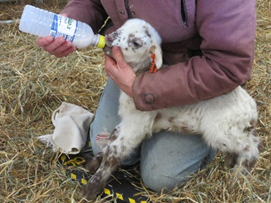
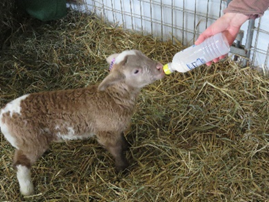
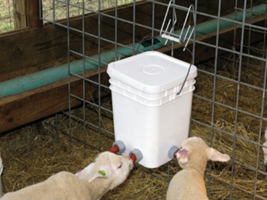
To introduce lambs to a bottle, hold them close against your body with your arm and use your hand to position their head. Older, more experienced lambs will take a bottle standing on their own. Lambs less than 24 hours old are much easier to start than older lambs; if there’s any question a lamb may require supplementing later, it’s good to introduce the lamb to a bottle on day one. Once lambs are started, consider bucket feeding to reduce labor, especially for multiple bottle lambs.
Orphan lamb grafting
There are several reasons to graft lambs. Ewes may have too many lambs, or there may be one lamb who is much smaller than its siblings and not able to compete well. Mismothering events may create situations where lambs need to be grafted to their natural mother or to a foster ewe. Unfortunately, there are times when ewes become ill or die leaving orphan lambs to manage. Grafting works best with newborns who are less than 24 hours old but can be successful up to 2-3 days of age with a little patience.
Good foster candidates are mature ewes with a single live lamb born within the last couple of days; or ewe lambs that lost a single-birth lamb that same day. When possible, choose which lamb will be grafted in advance (active, vigorous lambs work best) but be flexible because it is best to have similar sized lambs in the grafted family. The size of the foster lamb is not always as important as the personality of the lamb. A small, but tough lamb will stay in the fight. You can find more detailed information in the Lamb Grafting Tips Blog
The Orphan Lamb Considerations Blog has some more detailed information about feeding and caring for bottle lambs.
Mastitis
Striping the wax plug from ewes teats after lambing makes it easier for lambs to start suckling and also enables you to see if there are milk flow issues. A ewe might have a nice, big udder but no milk and you will not know unless you check.
Udder edema usually starts in the last few days of pregnancy and ewes will often have swelling on their bellies, in front of the udder too. Milking is the best way to resolve edema as the teats might be too swollen for lambs to easily nurse. Remember to save the colostrum that you milk out and feed it to her lambs. Continue milking or assisting the lambs to drink until the swelling has resolved, usually about 24 hours.
Hard bag is when the milk producing tissue in the udder is replaced by scar tissue, either due to previous mastitis or OPP (Ovine Progressive Pneumonia). These ewes have udders that are big, feel hard and do not produce milk at all. You will have to bottle raise the lambs. Unless you know that the ewe in question had mastitis, it is good to test her for OPP. Cull her, unless you want to raise her lambs again next year.
Blocked teats can occur due to milk stone deposits in the teat canal or scar tissue. Usually only one teat will be affected and you might be able to get a little bit of milk out of the ewe, but you can feel a little blob or a ribbon of hard material in the teat canal. Sometimes you can milk these out by rolling it between your fingers and gently working it down the teat canal. Be gentle though. Your veterinarian should be able to remove the obstruction but scar tissue will lead to a smaller diameter teat canal that will always affect how easy it is for a lamb to suckle from her.
Most cases of mastitis are caused by common bacteria found in the environment or from the normal bacteria on the skin or in the mouths of sheep and lambs. Ewes confined in wet, dirty or crowded areas have a higher risk for exposure to these pathogens. To reduce environmental contamination, keep pens, bedding and areas around the barn clean and dry. Lambs with pneumonia can transmit the bacteria to the ewe’s udder while nursing. If a ewe has mastitis, separate her and her lambs from other ewes. When her lambs get hungry, they will steal milk from other ewes and spread the infection. When you see lambs stealing, check their dam for mastitis. You can find more information in the Udder Health in Ewes Blog
Lamb diseases to watch for
Making sure that your ewes receive good nutrition and lamb in adequate body condition should ensure good quality colostrum. Making sure that your lambing environment is clean and ensuring that lambs receive an adequate volume of good quality colostrum in the first 24 hours after birth will prevent most neonatal disease.
Watery Mouth
Watery mouth (also known as rattle belly or floppy lamb disease) is an often-fatal disease of newborn lambs caused by ingestion of E. coli bacteria usually from a dirty, muddy or wet environment. It affects lambs 12-72 hours old that have not ingested sufficient colostrum. Without the antibodies provided by colostrum, the bacteria rapidly multiply and trigger a chain reaction in the lamb’s gut. The gut motility stops and the stomach fills with gas resulting in a painful belly that causes the lamb to flop around in discomfort. The lamb may present with a wet muzzle caused by excessive salivation and a full belly appearance but will refuse to nurse and is lethargic and/or hypothermic. Lambs presenting with these symptoms or notably, not passing stool at all, should not be fed milk replacer. Treatment includes veterinary prescribed antibiotics, oral electrolyte therapy (often by tube), and warm soapy enemas to stimulate gut motility. The lamb has a decent chance at recovery if, after a few treatments, the urge to nurse resumes. Lambs most at risk are small multiple lambs born late (when the environment is more contaminated) who don’t receive adequate colostrum. This could be due to weakness, sibling competition, under-conditioned ewes, difficult birth, mismothering, or inadequate ewe supply of colostrum (e.g., yearlings with multiples). Watery mouth disease may be prevented by maintaining a clean, dry lambing environment and ensuring at-risk lambs receive adequate colostrum or colostrum replacer. Keep the clinical symptoms of this disease in mind as they can be mistaken for other common newborn lamb illnesses.
Joint Ill (or Navel Ill)
This is a relatively common bacterial infection in lambs 1-4 weeks of age. Bacteria (usually Streptococcus) enters the bloodstream via the navel, after tagging or castration. Early signs include a sudden onset of lameness in one or more legs, warm and swollen joints (polyarthritis), fever and anorexia. Often the lambs appear hunched and unthrifty. Early treatment with antibiotics affects outcome. A 5-7-day course of antibiotics should be initiated early to prevent severe acute infection or death. Failure to complete the full course of antibiotics will often result in intermittent flare-ups and permanent joint damage. Effective antibiotics include Penicillin, Oxytetracycline and Nuflor. Dexamethasone is often used to reduce joint pain and swelling. Prevention: Dip navels with iodine soon after birth. Use an antiseptic during invasive procedures, keep bedding clean and dry to reduce bacterial contamination, and avoid crowding. Lambs who have received adequate colostrum are less likely to become affected due to a stronger immune system. For more information see the Cornell University’s SOP on Joint Ill in lambs
Scours
Scours occurring in dam-raised newborn lambs are usually caused by bacteria, viruses or protozoan infections and can be prevented by ensuring adequate colostrum and a clean environment. Scours in artificially-reared lambs can be caused by the same organisms but is usually due to improper mixing, feeding and storage of milk replacer. You can find more information in the Scours: Causes, Treatment and Prevention Blog
Lamb Pneumonia
Lambs with pneumonia look depressed and do not nurse well. They might cough, have raspy breathing and nasal discharge but often you will just see a lamb that looks sick. Always take a temperature on sick lambs as pneumonia causes fever. Newborn lambs do not have a lot of body reserves and if they are not treated promptly can develop sepsis and die rapidly. Typically, neonatal pneumonia is seen in flocks that lamb in barns; ensuring adequate ventilation will go a long way in preventing disease. Get down on your knees and smell the air at lamb level. If your knees get wet and the ammonia irritates your nose, it is definitely not a healthy environment for the lambs. Make sure you add enough bedding, especially if it is very humid during lambing, and do not kill your lambs with kindness by shutting up the barn too tightly. Lambs that are dry and away from drafts will do fine in cold temperatures. Lambs that do not receive an adequate amount of high-quality colostrum are likely to succumb to pneumonia.
Lambs that are born back feet first often aspirate birthing fluids if they start breathing before their head is out. Usually, they can cough out this material but, if severe, it can lead to pneumonia. Be sure to watch them closely for a few days and consider treating them proactively with antibiotics if their breathing sounds raspy. Difficult bottle lambs sometimes aspirate milk replacer if you really have to fight with them when training them to a bottle. Be aware that this can also cause pneumonia.
Lambing is a lot more fun and it sets a good tone for the whole growing season if ewes and lambs are healthy and vigorous. We hope that this compilation of lambing materials will help you to be successful this lambing season.
Comments and questions can be sent to blogs@easternalliancekatahdins.com or join the conversation at https://www.facebook.com/easternalliancekatahdins
By: EAPK Communications Committee

